


Chapter 4By boat, from east to west
Cacela Velha: What to see, the history and the beach opposite
From the boat, Cacela Velha first appears as a white line on top of the cliff: the wall, the church tower, the whitewashed houses. Down below, the lagoon changes colour with every tide. In this chapter: what to see in the village, a thousand years of history told in a few minutes, the best time to visit and how to get to the beach across the water.
What to see in Cacela Velha
You can see the village in half an hour, but you’ll want to stay all afternoon: there is no traffic, just whitewashed streets, shade in the square and the lagoon below. Four places, four stories. Tap “Learn more” on each one.
 1
The fortress
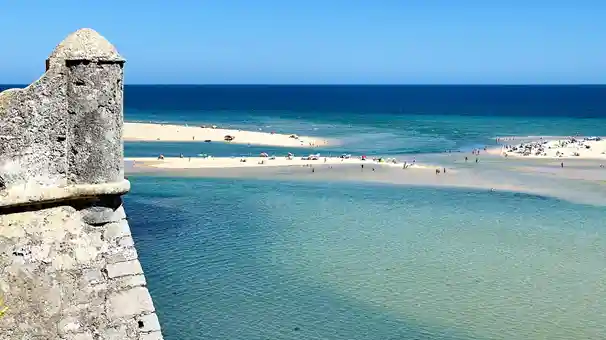
Walls on top of the cliff, facing the lagoon and the sea. Outside, the viewpoint has the widest view in the village.
Learn more
The Moors had a castle here in the 9th and 10th centuries. The 1755 earthquake brought down the bastions, and the cannons ended up on the beach. The fortress you see today was rebuilt afterwards.
2The church and the square
The white church, with the tower you see from the boat, opens onto a small square with benches and shade.
Learn more
The 1755 earthquake ruined the church, the Misericórdia and the town hall. Cacela was the seat of a municipality until 1775.
3The viewpoint
Down below, the channels, the sandbanks and the little lagoons change colour and shape with the tide.
Learn more
The cliff that holds up the village is a fossil cliff, about a million years old: the sea reached it before the lagoon existed.
4The whitewashed streets
Low houses, coloured doors and windows, Algarve chimneys and flowers on the walls. The whole village has been a Property of Public Interest since 1996.
Learn more
There is no traffic inside the village: leave the car at the entrance and do the rest on foot.
A thousand years of history, in a few minutes
- 713
Qast'alla Daraj
Cacela is under Muslim rule. Excavations in 2007 confirmed that there was an Islamic medina here.
- 9th and 10th centuries
The castle
The Moors build the castle on top of the cliff, watching over the coast.
- 958
A poet is born
Ibn Darraj al-Qastalli, “the one from Cacela”, one of the great poets of al-Andalus.
- 1240
The conquest
D. Paio Peres Correia conquers Cacela for the kingdom of Portugal.
- 17 July 1283
The charter
King Dinis grants Cacela its charter.
- 1755
The earthquake
The church, the Misericórdia, the town hall and the fortress bastions collapse.
- 1775
No longer a municipality
The seat moves elsewhere and Cacela becomes the quiet village we know today.
- 1892 a 1930
The factory that gave the beach its name
The Cacela Ceramics Factory made bricks, roof tiles and pipes by the lagoon. It disappeared, but the place kept the name Fábrica (factory).
- 1996
Heritage
The village is listed as a Property of Public Interest.
Did you know?
Tap a card to turn it over.
The beach across the water
From the viewpoint you see the other shore: a strip of white sand and dunes, with the open sea behind it. It is Fábrica Beach, and you can only get there by boat. The pier is a few minutes’ walk from the village, at the bottom of the road that goes down the cliff; the crossing is short and the beach, even in summer, has room for everyone.
Cross on foot at low tide? We don’t recommend it. The Vila Real de Santo António council advises against it: opposite the village is not a bathing area, there are no lifeguards and, when the tide goes out, the currents pull towards the sea. Fábrica Beach, where the boat drops you, is a lifeguarded bathing area during the bathing season.
How to get here
Leave the car at the entrance to the village or near Fábrica: the streets of Cacela Velha are for walking.
By water, Cacela Velha is the end of some of our tours: from the Fábrica pier, in 30 minutes, you go out to the inlet and the lagoons and back, with the village always in view. From Tavira, the tour to Cacela Velha and Cabanas takes about 2 hours.
The village is next to the Algarve Ecovia do Litoral, which links Vila Real de Santo António with Sagres. By bike, Manta Rota is very close; Cabanas and Tavira make a half-day ride.
When to go
Late afternoon
The sun sets towards Tavira and lights the village head-on. It is the most beautiful time for photos, especially from the viewpoint.
At low tide
The sandbanks, the lagoons and the shellfish gatherers at work appear. At high tide, the water rises and turns emerald green. Check the times on our tides page.
Outside summer
From spring to autumn the village is quieter and the light softer. In winter there are flamingos and passing birds on the lagoon.
With time
Combine Cacela Velha with a boat tour: from the water you understand why the village was built up there.
Quick quiz
Three questions about Cacela Velha
Roughly how old is the cliff the village stands on?
Where does the name Fábrica Beach come from?
Who conquered Cacela in 1240?
Frequently asked questions
Is Cacela Velha worth visiting?
Yes. It is one of the prettiest villages in the Algarve: small, white, on top of a cliff above the Ria Formosa, with a fortress, a church and a wide view over the water. You can see it in half an hour, but it is best to stay until the late afternoon.
How do you get from Cacela Velha to the beach?
By boat, from the Fábrica pier, a few minutes’ walk from the village: €1.50 return per adult. We don’t recommend crossing on foot at low tide: it is not a bathing area and the currents are strong.
Are there boat tours in Cacela Velha?
Yes. A tour of about 30 minutes leaves from the Fábrica pier to the inlet and the lagoons, with the village always in view. There are also longer tours to Cabanas, Tavira and Santa Luzia.
What is the best time to photograph Cacela Velha?
In the late afternoon, when the sun lights the village head-on. On the lagoon side, low tide shows the sandbanks; high tide turns the water emerald green.
